
Open and Laparoscopic Breast Surgeries
Breast Surgery & Minimally Invasive Breast Procedures
Best Breast Surgeon in Hyderabad – Advanced Minimally Invasive Treatment
Breast Problems: When Should You Consult a Breast Surgeon?
Breast problems can affect women and men at different stages of life and may range from benign conditions such as fibroadenoma, breast cysts and mastitis to more serious conditions including breast cancer. A new breast lump, persistent breast pain, nipple discharge, changes in breast shape or skin, or swelling in the armpit should not be ignored. Although many breast lumps are non-cancerous, early clinical evaluation is important for accurate diagnosis and timely treatment.
A breast examination usually begins with a detailed medical history and physical examination. Depending on the patient’s age, symptoms and clinical findings, investigations such as breast ultrasound, mammography, breast MRI and fine-needle aspiration cytology (FNAC) or core-needle biopsy may be recommended. These investigations help distinguish benign breast disease from conditions that require surgical treatment.
For patients who require an operation, modern surgical techniques aim to achieve effective disease control while reducing unnecessary tissue trauma and improving postoperative recovery. Dr. Md. Samiuddin, a General and Laparoscopic Surgeon in Hyderabad, evaluates each patient individually and recommends an appropriate treatment strategy based on the diagnosis, location and extent of the breast condition.
Common Breast Problems and Conditions:
Breast conditions can present in several different ways. Some common breast problems include:
- Fibroadenoma – a common benign breast tumor, particularly in younger women.
- Breast cysts – fluid-filled sacs that may cause a lump or tenderness.
- Breast abscess – a collection of pus associated with infection and inflammation.
- Mastitis – inflammation of breast tissue that can occur with or without infection.
- Benign breast lumps – non-cancerous growths or changes within breast tissue.
- Gynecomastia – enlargement of male breast tissue caused by hormonal or other underlying factors.
- Nipple discharge – discharge that may occur due to hormonal changes, infection, duct-related conditions or, less commonly, malignancy.
- Breast cancer – a malignant tumor that requires specialist evaluation and an appropriate multidisciplinary treatment plan.
- Axillary lumps or lymph-node enlargement – swelling in the armpit that may be related to infection, benign disease or breast malignancy.
Not every breast lump requires surgery. Treatment depends on the underlying diagnosis, symptoms, imaging findings, biopsy results and overall health of the patient.
Breast Lump Symptoms: How Can You Identify a Breast Problem?
One of the most common questions patients ask is: “How do I know if a breast lump or breast change needs medical attention?”
Watch for changes such as:
- A new lump or thickened area in the breast
- A lump in the armpit
- Persistent breast pain or tenderness
- Change in breast size or shape
- Skin dimpling, puckering or unusual thickening
- Redness, warmth or swelling
- Changes around the nipple
- Nipple inversion that is new or unusual
- Persistent or blood-stained nipple discharge
- A wound or ulceration on the breast skin that does not heal
It is important to remember that symptoms alone cannot determine whether a breast condition is benign or malignant. For example, breast cancer can sometimes occur without pain, while benign conditions can produce noticeable lumps or discomfort. Therefore, a new or persistent breast change should be assessed by a qualified doctor rather than self-diagnosed.
Diagnosis and Evaluation
How Are Breast Problems Diagnosed?
A proper diagnosis is the first step toward choosing the right breast treatment. During consultation, Dr. Md. Samiuddin may assess the patient’s symptoms, medical history, family history and physical findings before determining whether further investigations are required.
Common diagnostic methods include:
- Clinical Breast Examination:
A physical examination helps identify the location, size, consistency and mobility of a breast lump and checks for associated lymph-node enlargement. - Breast Ultrasound:
Ultrasonography can help differentiate solid and cystic lesions and is particularly useful for evaluating palpable breast lumps. - Mammography:
Mammography uses low-dose X-rays to evaluate breast tissue and identify suspicious areas or calcifications. - FNAC or Core-Needle Biopsy:
When tissue diagnosis is required, a sample may be obtained for cytopathological or histopathological examination. - Breast MRI:
In selected patients, magnetic resonance imaging can provide additional information about breast tissue and the extent of a suspected lesion.
The final treatment decision should be based on the clinical examination, imaging and pathology findings rather than on symptoms alone.
Breast Surgery in Hyderabad: What Treatment Options Are Available?
The treatment for a breast condition depends entirely on its cause. Some benign breast conditions can be monitored or treated with medication, aspiration or other non-surgical methods, while selected conditions may require surgical removal.
Depending on the diagnosis, surgical procedures may include excision of benign breast lumps, fibroadenoma excision, breast abscess procedures, treatment of gynecomastia and selected minimally invasive/endoscopic procedures involving the breast or axillary region.
For suspected or confirmed breast cancer, treatment planning is more complex. Depending on the stage and characteristics of the cancer, treatment may involve surgery such as breast-conserving surgery or mastectomy, together with other treatments such as chemotherapy, radiotherapy, endocrine therapy or targeted therapy. Such cases require appropriate oncological evaluation and should not be represented as routinely treatable by laparoscopic surgery alone.
Laparoscopic and Minimally Invasive Breast Surgery
What Is Laparoscopic Breast Surgery?
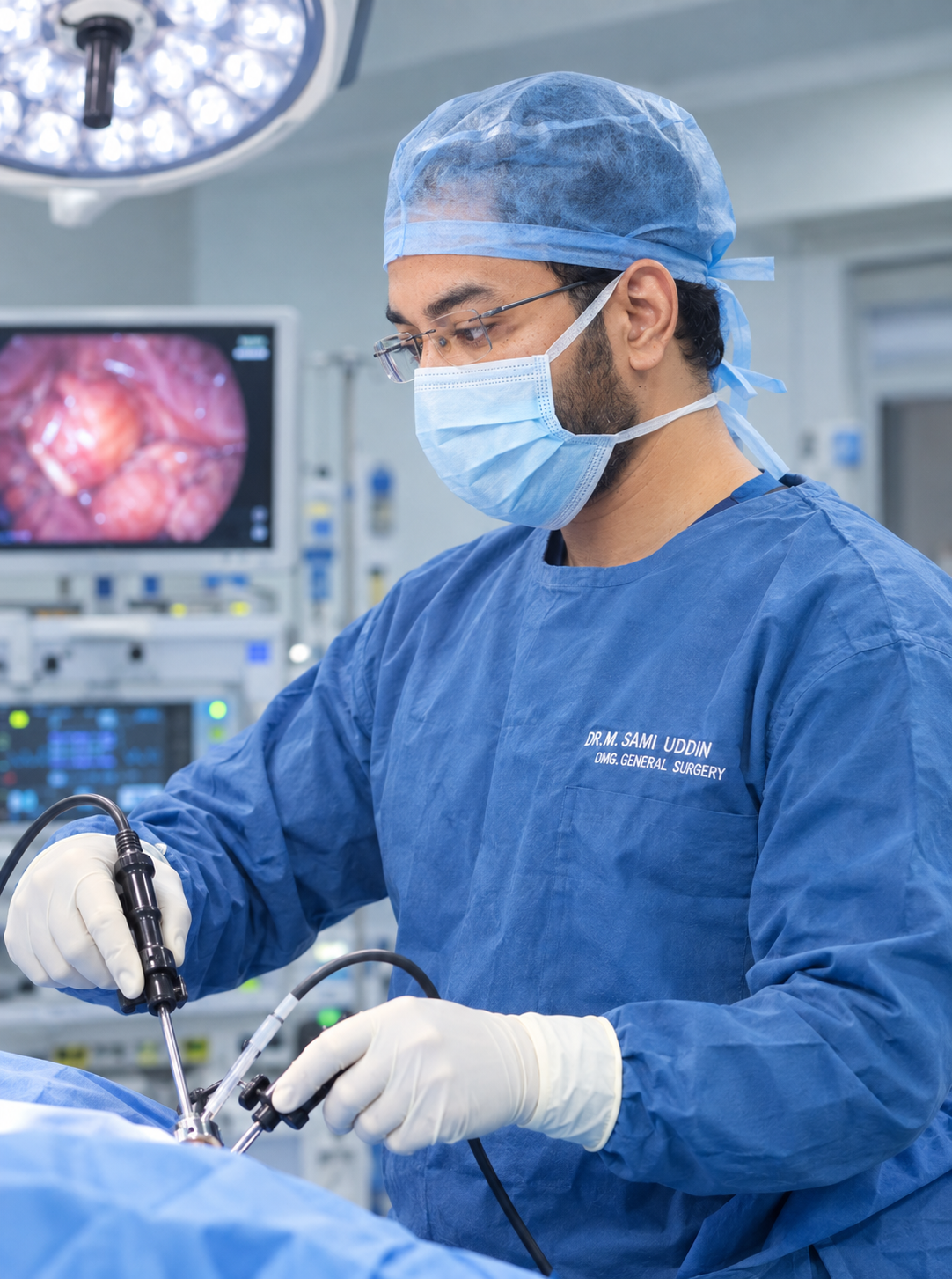
Laparoscopic surgery uses a camera and specialized instruments introduced through small incisions to perform procedures while avoiding a large conventional surgical incision. In breast-related surgery, minimally invasive or endoscopic techniques may be used selectively, particularly for procedures involving the axillary region, selected breast conditions and certain reconstructive or access approaches.
The term “laparoscopic breast surgery” is sometimes used broadly online, but patients should understand that not every breast operation can or should be performed laparoscopically. The appropriate surgical approach depends on the disease, anatomy, size and location of the lesion, and the patient’s individual circumstances.
Dr. Md. Samiuddin’s expertise in general and laparoscopic surgery can be valuable when evaluating patients who may benefit from minimally invasive surgical techniques. After clinical assessment and appropriate investigations, the most suitable surgical approach can be discussed with the patient.
Benefits of Minimally Invasive Breast Surgery:
- Smaller incisions and less tissue damage
- Less postoperative pain and discomfort
- Minimal and less noticeable scarring
- Faster mobilization and recovery
- Earlier return to routine activities
Patients should understand that “scarless breast surgery” does not literally mean that there is no incision or scar. Minimally invasive surgery aims to make incisions smaller and, where possible, place them in less conspicuous locations. The final scar depends on the procedure, surgical technique, healing response and individual patient factors.
Similarly, laparoscopic surgery is designed to reduce surgical trauma, but completely painless surgery cannot be guaranteed. Modern anaesthesia and postoperative pain-management techniques can, however, help keep discomfort under control.
Post-Surgery Care & Recovery Tips
- Keep the surgical area clean and dry
- Take prescribed medicines as advised
- Avoid heavy lifting and strenuous exercise initially
- Attend scheduled follow-up appointments
- Report fever, excessive swelling, bleeding or unusual discharge promptly
Recovery depends on the type and extent of the procedure, the patient’s general health and whether additional treatment is required. Patients undergoing selected minimally invasive procedures may experience earlier mobilisation and a faster return to routine activities than patients undergoing larger open operations.
In appropriately selected cases, patients may be able to resume light daily activities within a few days. Some patients can become active within 2–3 days, but this should be considered a possible recovery timeline rather than a guarantee. Strenuous exercise, heavy lifting and other activities should only be resumed according to the surgeon’s postoperative instructions.
Following surgery, patients should attend scheduled follow-up appointments so that wound healing, pathology results and recovery can be assessed.
Risks of Leaving Breast Problems Untreated
- Breast lumps may increase in size or become painful
- Infections may worsen and form an abscess
- Persistent symptoms may affect daily activities
- Some serious conditions may progress if diagnosis is delayed
- Delayed evaluation of breast cancer can allow disease progression
Why Choose Dr. Md. Samiuddin for Breast Surgery in Hyderabad?
Choosing a surgeon for breast surgery involves more than searching for a procedure name. Patients should consider the surgeon’s qualifications, experience, surgical approach, diagnostic evaluation and ability to determine whether surgery is actually necessary.
Dr. Md. Samiuddin is a General and Laparoscopic Surgeon in Hyderabad with a focus on minimally invasive surgical techniques. His surgical expertise can help patients receive an appropriate evaluation for breast lumps and other breast-related surgical conditions and understand the available treatment options.
Patients searching online for the best laparoscopic breast surgeon in Hyderabad should look beyond rankings and consider factors such as relevant surgical qualifications, experience with the proposed procedure, appropriate diagnostic evaluation, hospital facilities, anesthesia support and postoperative follow-up.
For a patient who is searching for the best laparoscopic breast surgeon in Hyderabad, the appropriate treatment should always be determined after a clinical examination and necessary investigations rather than solely through online information.
If a patient has discovered a new breast lump, persistent breast symptoms or an unexplained change in the breast or axilla, consulting an experienced general and laparoscopic surgeon in Hyderabad can help establish whether observation, diagnostic testing, medication or surgery is appropriate.
Book an Appointment with Best Breast Surgeon in Hyderabad
A breast lump or breast-related symptom does not always indicate cancer, but it should never be self-diagnosed. Timely examination, appropriate imaging and, when necessary, pathological evaluation are essential for determining the correct treatment.
If you are looking for a General and Laparoscopic Surgeon in Hyderabad for evaluation of a breast lump or another breast-related surgical condition, Dr. Md. Samiuddin can assess your condition, explain the available treatment options and determine whether a minimally invasive approach is appropriate for you.
- What is the best treatment for a breast lump?
- Is laparoscopic breast surgery painful?
- Is laparoscopic breast surgery scarless?
- How long does it take to recover from breast surgery?
- Who is the best laparoscopic breast surgeon in Hyderabad?
Treatment depends on the cause of the lump. A breast examination, imaging and sometimes a biopsy are needed before deciding whether observation, medication or surgery is appropriate.
Minimally invasive breast procedures generally involve smaller incisions and may cause less postoperative discomfort than conventional open surgery. Pain is managed with appropriate medication.
Laparoscopic or minimally invasive surgery uses smaller incisions, which can result in less noticeable scars. However, completely scarless surgery cannot be guaranteed.
Recovery depends on the procedure and the patient’s health. After selected minimally invasive procedures, patients may resume light activities within a few days, while more extensive surgery may require longer.

A surgeon you can rely on
Distinctively exploit optimal alignments for intuitive bandwidth. Quickly coordinate e-business applications.
Home visits
Progressively maintain extensive infomediaries via extensible niches. Dramatically disseminate metrics.
Emergency services
Appropriately empower dynamic leadership skills after business portals. Globally myocardinate interactive supply.
Great facilities
Dynamically target high-payoff intellectual capital for customized technologies. Objectively integrate emerging core.
Reliable nursing staff
Distinctively re-engineer revolutionary meta-services and premium architectures. Intrinsically incubate intuitive opportunities.
Premium facilities
Compellingly embrace empowered e-business after user friendly intellectual capital. Interactively actualize front-end processes.
Quick Links
Subscribe
Sign up for Dr Md Samiuddin newsletter to receive all the updates.